Every filmmaker remembers certain projects differently.
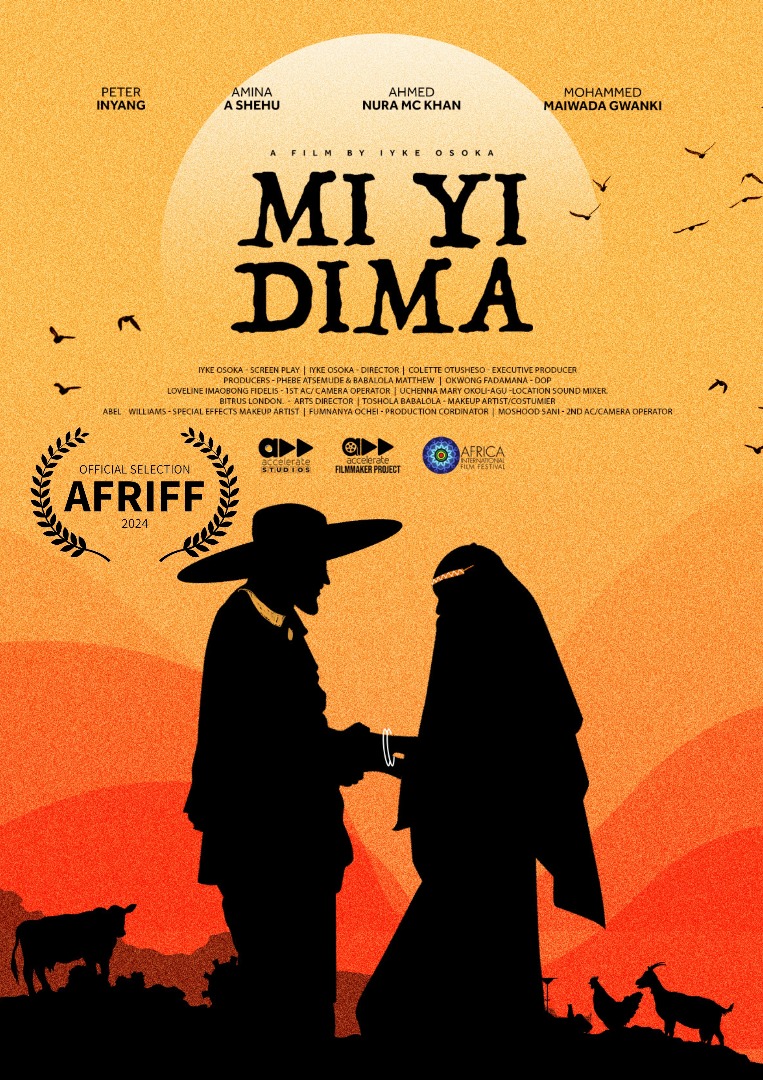
There are productions that pass through your hands as assignments and there are those that stay with you long after the final cut has been exported. Mi Yi Dima belongs firmly to the latter category for me.
As a writer and producer working in Northern Nigeria, I have spent years listening to stories. Some were told around family gatherings, others emerged from conversations in markets, villages, schools, and community spaces. What has always struck me is the abundance of stories that exist around us and yet how few of them find their way to the screen. For all the conversations about the growth of Nigerian cinema, vast parts of Northern Nigeria remain largely unexplored as storytelling landscapes. This reality was one of the reasons Mi Yi Dima became important to me.
From the beginning, the project was never simply about making another short film. It was an opportunity to engage with questions that many communities in Northern Nigeria continue to grapple with; questions about identity, tradition, choice, love, family, and the often-complicated relationship between personal desire and communal expectations. These are not uniquely Northern questions, they are human questions. Yet they unfold within a cultural environment that possesses its own language, values, rhythms, and worldview.
Too often, conversations about the North are framed through a narrow lens. News headlines tend to focus on conflict, politics, or crisis. While these realities cannot be ignored, they do not tell the whole story. Beyond the headlines are ordinary people navigating ordinary lives. There are mothers making sacrifices for their children, young people dreaming of different futures, families negotiating change, communities preserving traditions, and individuals wrestling with choices that will shape the course of their lives… these are stories worthy of cinema.
Producing Mi Yi Dima reminded me that authenticity is one of the greatest responsibilities a filmmaker carries. Authenticity is often discussed in terms of costumes, language, or location, but I have come to believe that it begins much earlier than that. It begins with respect. It requires a willingness to understand the people whose experiences are being represented and a commitment to portraying them with dignity and honesty.
Throughout the production process, we constantly returned to a simple question: Does this feel true? Not true in a technical sense, but true emotionally and culturally. Would people from these communities recognize themselves in these characters? Would they see something familiar in the relationships, the conversations, the silences, and even the conflicts? Those questions influenced every creative decision we made.
What fascinated me most about the film was its ability to explore difficult themes without turning them into accusations. One of the observations made about Mi Yi Dima was its engagement with themes of love, loss, and legacy within a distinctly Northern context. The film did not seek to condemn tradition, nor did it attempt to romanticize it. Instead, it invited audiences to sit with the complexities that emerge when individuals must make choices within systems and structures larger than themselves. For me, that is where meaningful storytelling often begins not in providing answers, but in creating space for reflection.
The production itself also reinforced something I have long believed about filmmaking in Northern Nigeria. Despite the challenges that often accompany production outside major industry centres, there is tremendous creative potential within the region. Limited infrastructure can be frustrating, and logistical constraints can test even the most experienced producer, but these realities often demand a different kind of creativity. They force filmmakers to become resourceful, collaborative, and deeply connected to the communities in which they work. Some of the most rewarding moments during production had little to do with cameras or equipment. They came from conversations with community members, from witnessing how people responded to seeing their realities represented, and from realizing that storytelling remains one of the most powerful tools for cultural preservation and social engagement.
As African cinema continues to gain international attention, there is growing interest in stories that are rooted in specific cultural experiences. This shift is encouraging because it challenges the long-held assumption that stories must abandon their local identity in order to achieve global relevance. My experience has shown the opposite to be true. The stories that travel furthest are often those that remain closest to home, audiences connect with honesty.
A story told in Hausa can resonate with someone who has never visited Northern Nigeria. A character navigating cultural expectations in Katsina can speak to someone living thousands of miles away. What bridges that distance is not geography; it is humanity, that realization sits at the heart of why projects like Mi Yi Dima matter. The future of African cinema will not be built solely by telling bigger stories. It will be built by telling deeper ones. It will be shaped by filmmakers willing to explore communities that have been overlooked, languages that have been underrepresented, and experiences that have not yet received the attention they deserve.
Northern Nigeria remains one of the richest storytelling environments on the continent. Its histories, cultures, traditions, and contemporary realities offer an endless reservoir of narratives waiting to be explored. The responsibility of filmmakers from the region is not merely to tell these stories, but to tell them with care, courage, and craft. Looking back, Mi Yi Dima reinforced a lesson I continue to carry into every project: stories rooted in a place often have the greatest power to transcend the place. The more honestly we tell our stories, the more deeply they connect with others. And perhaps, that is the enduring promise of cinema that a story born in one community can ultimately belong to the world.